Your Company Already Knows. Its AI Still Cannot Remember.
Why more context is not organizational memory, why contradictions should surface rather than disappear, and what dependable company AI needs before it can act.
By Red Orca Team
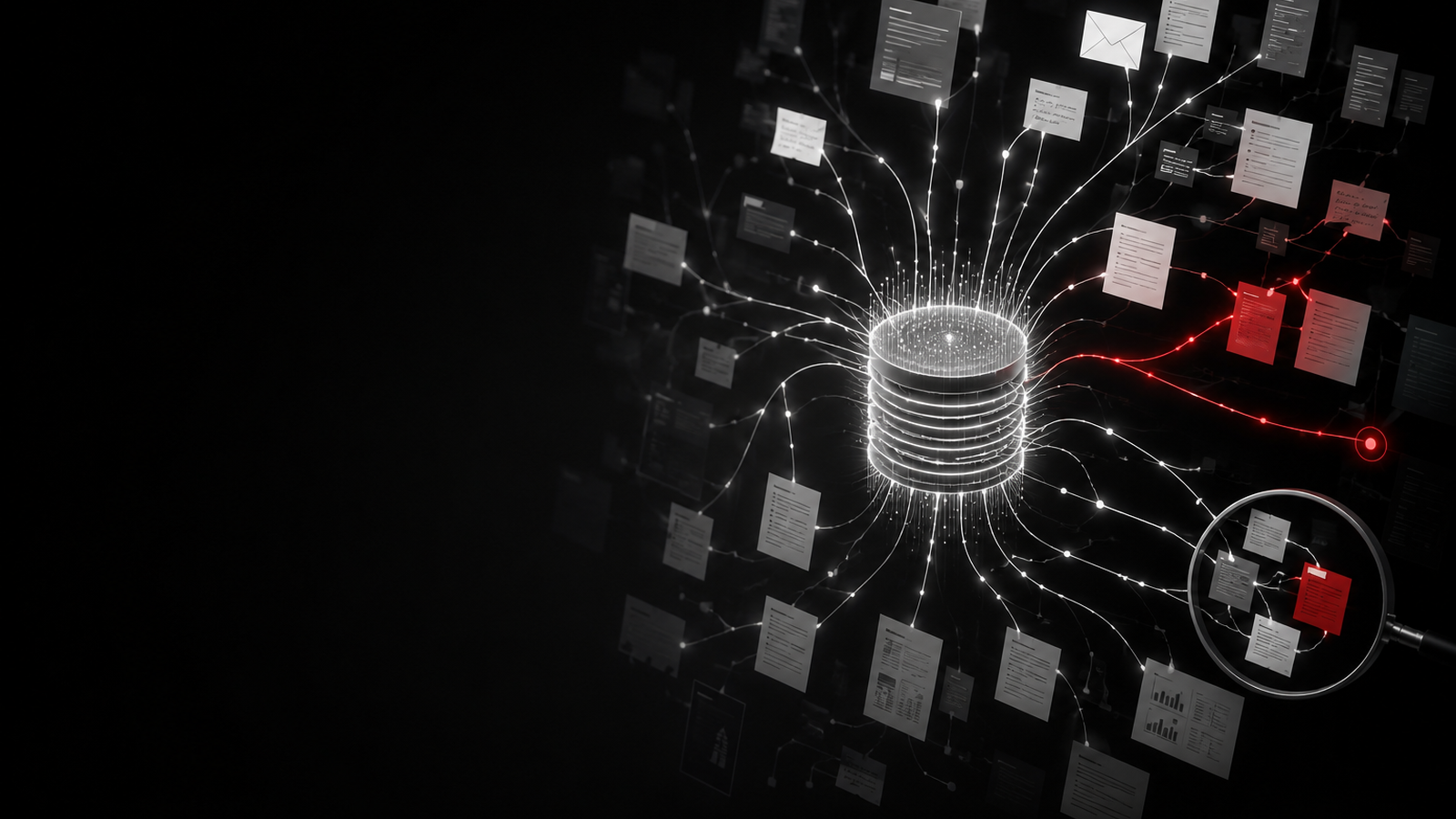
Imagine a company preparing for a customer launch.
The signed proposal says 30 September. A meeting transcript says the middle of the month. An email from delivery says the date depends on a security review. All three records are real. None tells the whole story alone.
Ask a general AI assistant for the launch date and it may return one clean answer. It might choose the most recent sentence, the most frequently repeated date or the passage its retriever happened to rank first. The answer may sound certain even when the company record is not.
A dependable system should do something less magical and more useful: show the disagreement, identify each source, explain which record carries authority and ask a person to confirm the conclusion.
That is the difference between access to information and organizational memory. It is also the difference between an assistant that saves time and one that quietly manufactures a new version of the company's history.
The company does not have a data shortage
Most businesses already produce more evidence than any one employee can hold: email threads, proposals, meeting notes, support tickets, contracts, chat messages and project updates. The problem is that decisions, commitments and exceptions are distributed across them. Storage preserves the files. It does not preserve what the organization meant.
Atlassian's 2025 State of Teams research, based on 12,000 knowledge workers and 200 executives, found that leaders and teams spend 25% of their time searching for answers. Microsoft's 2026 Work Trend Index reaches a related conclusion from a different direction: organizational conditions account for twice the reported AI impact of individual effort alone. Better prompting helps an employee. Shared operating memory helps the company.
Source: Atlassian, “State of Teams 2025”
Source: Microsoft, “2026 Work Trend Index: Agents, human agency, and the opportunity for every organization”
A commissioned 2026 Wakefield Research study published by Teradata makes the context problem explicit. Among 1,000 senior technology and data leaders across six markets, 77% said that no more than one fifth of their enterprise data was sufficiently described and contextualized for agents to use. Seventy-eight percent said unifying data and knowledge across business functions was challenging.
Those are vendor-sponsored survey findings, not universal facts. But they describe a familiar failure mode: the company possesses the information while the system lacks the lineage, relationships and authority needed to use it safely.
Source: Teradata / Wakefield Research, “Why Enterprise Agentic AI Stalls Before It Scales,” 7 July 2026
More context is not the same as memory
The most tempting answer is to place more material inside a larger context window. If the model can read every document at once, surely it can understand the company.
The evidence is less reassuring.
The peer-reviewed “Lost in the Middle” study tested language models on multi-document question answering and key-value retrieval. Performance often peaked when relevant information appeared near the beginning or end of the context and degraded when the same information appeared in the middle, including for models designed for long context.
A larger window changes how much text a model can receive. It does not automatically tell the system which document is current, which sentence was superseded, whether a number is approved, who owns a commitment or why two sources disagree.
Source: Liu et al., “Lost in the Middle: How Language Models Use Long Contexts,” TACL 2024
Organizational memory needs relationships, not just passages
Search answers “Where was this mentioned?” Organizational memory has to answer harder questions: What was decided? By whom? When? Against which alternative? Is the decision still active? What changed afterward?
That means a useful memory layer cannot be a folder of summaries. Each extracted item needs enough structure to be challenged:
- Source: the exact sentence or passage supporting the claim.
- Time: when the source was created and whether a newer record supersedes it.
- Authority: whether the statement came from a signed agreement, an internal draft or an informal conversation.
- Ownership: the person or role accountable for the decision, promise or next step.
- Status: proposed, confirmed, completed, cancelled, disputed or still unresolved.
- Access: who is allowed to see the underlying material and who may confirm or change the extracted record.
Without those relationships, a system can retrieve an accurate sentence and still produce the wrong business answer. The passage may be genuine but obsolete. The promise may be real but never approved. The deadline may exist but have no owner.
A contradiction is a finding, not a failure
Many AI interfaces are optimized to produce one smooth response. Business records are not smooth. Two documents may contain different contract values. Finance and sales may use different renewal dates. A meeting can end without a recorded outcome.
The wrong system resolves that discomfort silently. The right system preserves the disagreement and makes it reviewable. It should quote both sources, explain why they conflict and let an authorized person decide which record governs.
This is why evidence attribution matters beyond avoiding hallucinations. NIST's current work on evaluation probes for agentic AI separates faithfulness, completeness and sufficiency: whether a source supports the claim, whether the answer captures the source's full message and whether the evidence is strong enough for the conclusion. A citation is useful only when it carries the real evidentiary burden of the answer.
Source: NIST, “Building Evaluation Probes into Agentic AI,” updated 5 May 2026
Memory is also an attack surface
Persistent memory gives an agent continuity. It also gives bad information a longer life.
OWASP now treats memory and context poisoning as a distinct agentic risk. Its May 2026 analysis of the MemoryTrap vulnerability explains why: malicious content reached persistent memory and trusted configuration, allowing one routine interaction to influence future reasoning across sessions. The danger was not only that the agent read untrusted content. It was that the system carried the content forward as if it deserved trust.
A business memory system therefore needs the same discipline applied to other sensitive control surfaces. Ingestion should preserve provenance. Retrieved content should not become instruction. Permissions should travel with the source. Changes should be visible. Suspicious or low-confidence material should be quarantined or reviewed rather than quietly promoted into durable truth.
Source: OWASP GenAI Security Project, “Memory Is a Feature. It Is Also an Attack Surface,” 13 May 2026
The five tests for business-grade memory
Before a company lets an AI system remember on its behalf, it should be able to answer five practical questions:
- Provenance: Can every extracted claim be traced to the exact source passage?
- Contradiction: Does the system surface disagreement instead of averaging it into one answer?
- Authority: Can it distinguish an approved decision from a draft, suggestion or casual remark?
- Control: Can a person confirm, reject, correct and delete what the system proposes to remember?
- Security: Are access rights, ingestion paths, changes and downstream uses visible and enforceable?
A system that fails these tests may still produce impressive summaries. It should not yet be treated as the company's record.
What this means for Red Orca
Our first briefing argued that intelligence is not permission. Our second examined why impressive AI experiments fail to become measurable production systems. This third issue adds the missing operational layer: an agent cannot act reliably for a business if the business record it depends on is fragmented, unverified or unsafe to retain.
Red Orca is now organized around three specialized systems. They solve different problems, but they share one requirement: important work must remain inspectable.
1. Shark: organizational memory
Shark's live browser preview reads PDF, Word, text and Markdown files locally on the user's device. It proposes decisions, commitments, risks and facts; quotes the sentence behind each item; surfaces contradictions; ranks urgency; and leaves confirmation to a person. The preview is available without signup, and team deployments begin with a pilot using the organization's own documents.
2. Oyster: cybersecurity intelligence
Oyster is live as Red Orca's cybersecurity AI agent. It gives users a dedicated place to investigate security questions, explore vulnerability intelligence and turn technical findings into clearer next steps. The current product can be opened free with an account.
3. Dolphin: voice and email
Dolphin remains in private beta with a live voice demo and early paid access from €5 per month. It brings outbound calling and cold email into one console: qualifying conversations, finding businesses, drafting messages and sending from the user's mailbox, with approval before email is sent.
Update, 28 September 2026: Dolphin is no longer in private beta — it is open to every Red Orca account, with paid plans from €5 a month (Dolphin). For what Oyster offers an account today, see the Oyster page.
Shark remembers. Oyster investigates. Dolphin communicates. The goal is not to stretch one generic assistant across every department. It is to build focused systems whose data, permissions and outcomes can be understood.
Source: Red Orca, “Specialized systems. One connected intelligence,” product pages checked 31 August 2026
The Red Orca view
The next useful leap in business AI will not come only from models that accept more tokens or agents that take more actions. It will come from systems that help organizations retain the meaning of their own work.
That meaning is not a polished summary. It is the decision and its source. The commitment and its owner. The deadline and its status. The contradiction and the evidence on both sides. The action and the person who approved it.
Microsoft's 2026 Work Trend Index describes leading organizations as learning systems: they capture what worked, what failed and where outcomes drifted, then encode those signals into shared routines. The difficult part is not generating more information. It is deciding what deserves to persist, who may rely on it and how it can be corrected.
A company should not buy AI because it promises to remember everything. It should choose systems that can show what they remember, why they believe it, who is allowed to see it and when a human must decide.
The company already knows. The product opportunity is to make that knowledge usable without turning uncertainty into false confidence or private context into uncontrolled memory.
BRING US THE RECORD. If your team keeps rereading emails, meeting notes and documents to reconstruct what was decided, show us the record. We are opening conversations with teams that want to test organizational memory on a real, bounded workflow.
Visit redorca.tech | info@redorca.tech
Sources and research notes
- Microsoft, “2026 Work Trend Index: Agents, human agency, and the opportunity for every organization,” 5 May 2026
- Atlassian, “State of Teams 2025”
- Teradata / Wakefield Research, “Why Enterprise Agentic AI Stalls Before It Scales,” 7 July 2026
- Liu et al., “Lost in the Middle: How Language Models Use Long Contexts,” Transactions of the Association for Computational Linguistics, 2024
- NIST, “Building Evaluation Probes into Agentic AI,” updated 5 May 2026
- OWASP GenAI Security Project, “Memory Is a Feature. It Is Also an Attack Surface,” 13 May 2026
- Red Orca, product and privacy pages
Methodology: This issue was prepared using primary institutional, peer-reviewed and first-party company sources available as of 31 August 2026. Vendor-sponsored survey findings are explicitly attributed and should not be read as universal guarantees. Red Orca product descriptions were checked against the live website and distinguish live products, a browser preview and private-beta access. The opening launch scenario is illustrative, not a customer claim. This article is informational and is not legal, compliance or cybersecurity advice.
Join the Red Orca newsletter
Weekly insights on AI agents, automation, cybersecurity and what we're building at Red Orca.
By subscribing, you agree to receive Red Orca updates. You can unsubscribe at any time.
Want to see what Red Orca is building?